
MARGIT DOMBI | FIGYELŐ 2022/2
– What kind of guests do you expect at the hotel you are building in Debrecen?
– A large number of manufacturing businesses have established themselves in the city over the past few years, and that process is still under way. Those movements make further developments necessary in the service sector too, since more and more business people and senior executives are passing through Debrecen. Much of the international-standard service their needs call for is not yet available, or not in sufficient quantity or quality. In our judgement there is also a significant shortage of hotel capacity, which our four-star facility is intended to ease. The new hotel will belong to Mercure, one of the brands of the Accor group, the world's largest hotel operator. We work with the chain under an advisory agreement. The international backing helps with occupancy, while operation is carried out by the development company, Bajcsy Invest Kft.
– How good an idea was it to issue a corporate bond in the middle of the pandemic?
– The issue took place at exactly the moment in the pandemic when uncertainty in the market was at its greatest. Had we come to market with our paper three months earlier or three months later, we would almost certainly have achieved a coupon below 3 per cent. Even so, I cannot call the 3.41 per cent we realised a poor outcome — indeed, looking at how the base rate has moved, I have to say it is a good cost level today, and given mounting inflationary pressure it will probably look better still in future.
– Is the money raised from the bond issue used solely to finance the hotel investment?
– A significant part of our HUF 5 billion issue goes to the hotel development. It is needed, since banks are currently reluctant to finance tourism investment. For our residential park and industrial property developments we of course continue to draw on bank funding.
– How is the rise in financing costs shaping the construction industry and your projects in progress?
– Where we prepared the business plan on the interest terms prevailing earlier but have not yet signed a financing agreement, or signed one without a fixed rate, the interest cost — and with it the payback period — will increase significantly. That alone will not make us stop a project. For the investments in preparation, however, we naturally build the business plan on current forecasts, meaning today's rates. The big question in that case is which projects will be viable at present cost levels — that is, whether there will be demand able to pay for them. That arises most sharply in housing, because it is typically the kind of development where there is a level above which investors buying apartments hold off or shift towards the second-hand market. An industrial investor, by contrast, who wants to manufacture and needs a new building for it, has no choice but to accept the current cost level. Even so, we intend to remain present in the housing market while also strengthening our position in industrial development, together with the Xanga group.
– A few years ago you carried out a large office development together with the Debrecen municipality's asset management holding. How profitable did that prove?
– We took part in that from two sides: as co-investors with the city's asset manager in a joint project company, and as contractor through our principal construction company, Hunép Zrt. That company did the work. As developers we paid for it out of the joint company, and the company we part-own sold the property shortly after completion. Beyond the modest return, the greatest value of that investment is that as both developer and contractor we have a 32,000 square metre reference which, I believe, would stand up anywhere outside Hungary today. I regard it as an investment in the future; the return will come there, not from the one-off sale.
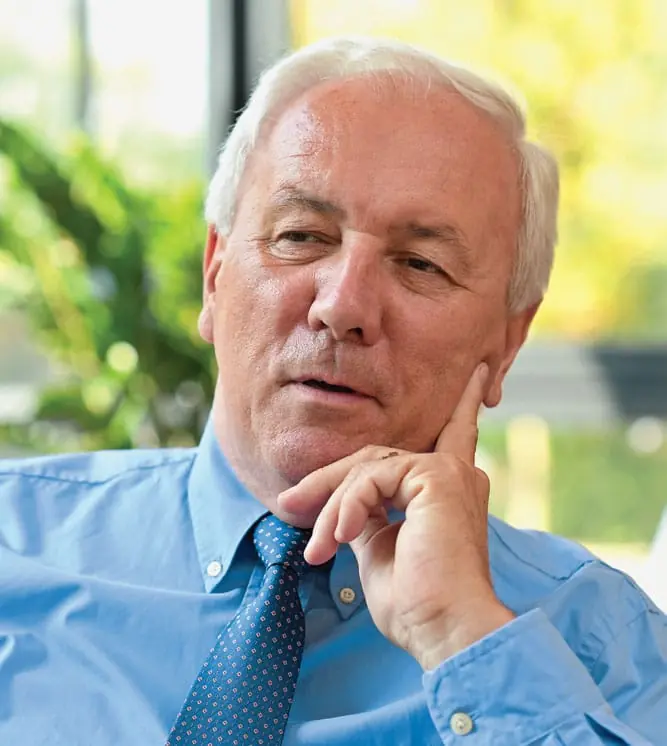
We intend to remain present
in the housing market while also
strengthening our position in
industrial developmentGYULA SZŰCS
– BMW recently announced that construction of offices and buildings for teaching "specialist BMW knowledge" will begin next year. How are you preparing for that?
– I do not think we will be a significant factor in shaping the car manufacturer's site, and I do not see that as a problem. I think we need to be thinking about the next tier. Of course, I am not saying that if a project on BMW's site is put out to competition and we are invited, we would not put both hands up. We will try to make a good offer and take part in the works, even in a small way. But it is no tragedy if it does not work out that way. I see more opportunity in developing and building logistics or production property for lease, suited to the needs of suppliers. And we are preparing for that. Through a company we hold jointly with the Xanga group, we bought a substantial site in Debrecen's Southern Industrial Park, where we will begin the first project this year. We intend to develop seventy thousand square metres of industrial buildings in total; the permitting process for the first phase is already under way.
– Szinorg's flagship is currently Hunép Zrt., which as a construction contractor brings in two-thirds of the Group's consolidated revenue. What do you expect on building material prices, and what trends do you see for the near future?
– What is happening in the construction market is very instructive, hard to assess and hard to understand. My firm view on building material prices is that for some products the increases are justified — I could not say by how much. When we read, for instance, that ore mines in India closed during the pandemic because there was nobody to do the work, I have to say the rise in iron and steel prices is to some degree well founded. When we hear there is a shortage of containers for sea freight, and that shipping costs from Asia to Europe have risen three- or fourfold as a result, I again think there are materials whose price increases are justified. When the price of every type of material rises by 20 to 40 per cent at the same moment, that gives one pause. It has put construction companies in a very difficult position, and it affects the Szinorg group's companies in the sector too. I think the government's stated intention to examine the background to these increases was a very good direction, but what can actually be done is a hard question, since rising energy prices and wage costs point to another wave of increases — which industry calculations suggest could reach twenty per cent in the first half of 2022. The rise could put particularly smaller, honest firms in a very awkward position: those working on longer projects under fixed-price contracts agreed a year or eighteen months ago, meaning they will not be able to pass on the additional material, energy, labour and interest costs we have discussed. Their finances may become more strained, which could cause real difficulty. That matters for the profession because there are already fewer reliable, good-quality specialist firms than are needed.
– How did last year go for you?
– Our expectations for 2021 were met at Group level, both on growth and on profitability. This year meets our expectations in terms of committed capacity, but the factors above may affect the success we have planned for.